
Living volcanoes in the Macaronesia: Canary Islands, Azores, Madeira and Cape Verde
Macaronesia is one of the most fascinating volcanic territories on the planet. Although many travelers are familiar with its beaches or green landscapes, few understand that the Canary Islands, Azores, Madeira and Cape Verde share the same geological origin: the fire that emerged from the bottom of the Atlantic Ocean.
Although volcanism manifests itself very differently in each archipelago, the Canary Islands, Azores, Madeira and Cape Verde share the same volcanic origin that explains much of their landscape, biodiversity and way of life. In this guide we analyze how fire is expressed in each territory,
what type of volcanoes you will find on each island and why understanding this phenomenon is key to understanding the identity of Macaronesia. A comparison designed for curious travelers, nature lovers and those looking to go beyond the surface of the destination.
1. Macaronesia: an Atlantic territory born of fire
Macaronesia is not just a geographical concept. It is a natural region formed by volcanic archipelagos that emerged thanks to hot spots, tectonic fractures and prolonged volcanic activity over millions of years.

Which archipelagos form the Macaronesia?
Canary Islands (Spain)
Azores (Portugal)
Madeira (Portugal)
Cape Verde (West Africa)
Although today they belong to different countries and are thousands of kilometers apart, their common volcanic origin explains many similarities: fertile soils, abrupt relief, extreme microclimates and a very direct relationship with nature.
Volcanoes in the Canary Islands: recent activity and extreme landscapes.
The Canary Islands is the archipelago where volcanism is most visible and recent. Here, volcanic activity does not belong to the remote past, but to the collective memory.
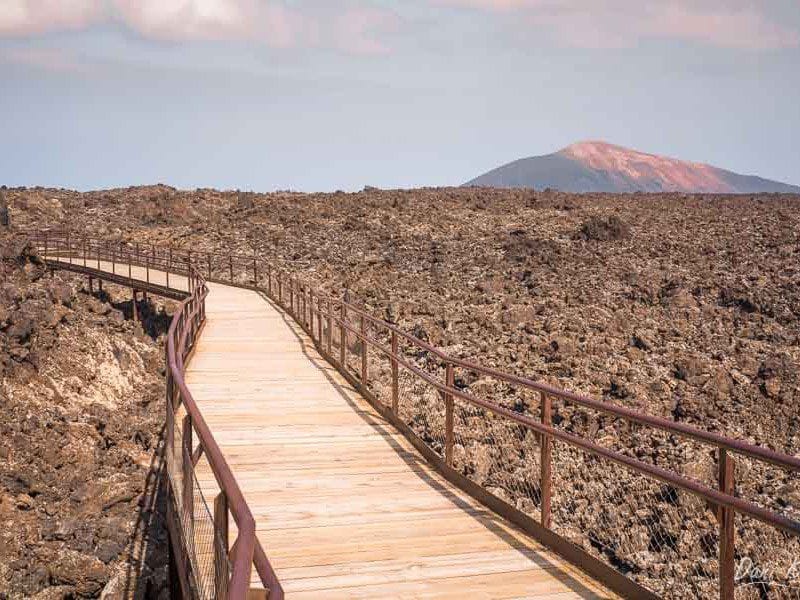
A landscape shaped by historical eruptions
Areas such as the Timanfaya National Park show an almost lunar territory, created after the eruptions of the eighteenth century. More recently, Cumbre Vieja reminded the world that the archipelago is still geologically active.

How the volcano conditions life in the Canary Islands
Architecture adapted to lava flows
Volcanic agriculture (vineyards, banana plantations)
Unique landscapes that attract volcanic tourism
Volcanism in the Azores: the force acting below the surface.
The Azores is one of the most geologically active places in Europe, although its volcanism usually manifests itself in a more discreet way.

Pico: the highest volcano in Portugal
The island of Pico is home to a stratovolcano that dominates the entire archipelago. Its presence is not only visual: it defines the climate, the vegetation and the local way of life.

Fumaroles, hot springs and underwater volcanoes
In the Azores, volcanic activity is felt in:
Active fumaroles
Natural hot springs
Extremely fertile soils
Here, the volcano does not explode: it breathes.
4. Madeira: dormant volcanoes, erosion and verticality.
Madeira has no active volcanoes at present, but all its relief is of volcanic origin. The passage of time and erosion have transformed ancient lava flows into spectacular landscapes.

An archipelago sculpted by time
The great cliffs, deep ravines and high plateaus exist thanks to ancient volcanism that, when it died out, gave way to marine and climatic erosion.
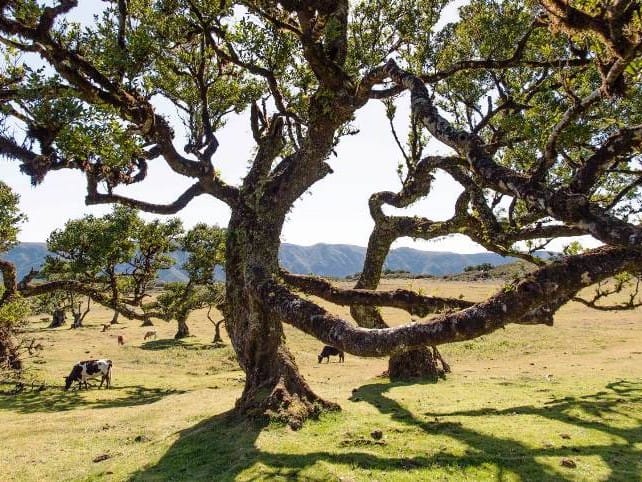
The link between volcanoes and laurel forests
Spaces such as Fanal are a direct consequence of the volcanic origin of the island, which allows the retention of humidity and the appearance of unique forests in Europe.
5. Cape Verde: when the volcano rules life
In Cape Verde, the volcano is not a landscape: it is the absolute protagonist.

Fogo Island and the active volcano
The island of Fogo is home to one of the most impressive active volcanoes in the Atlantic. The Pico do Fogo directly conditions the daily life of its inhabitants.
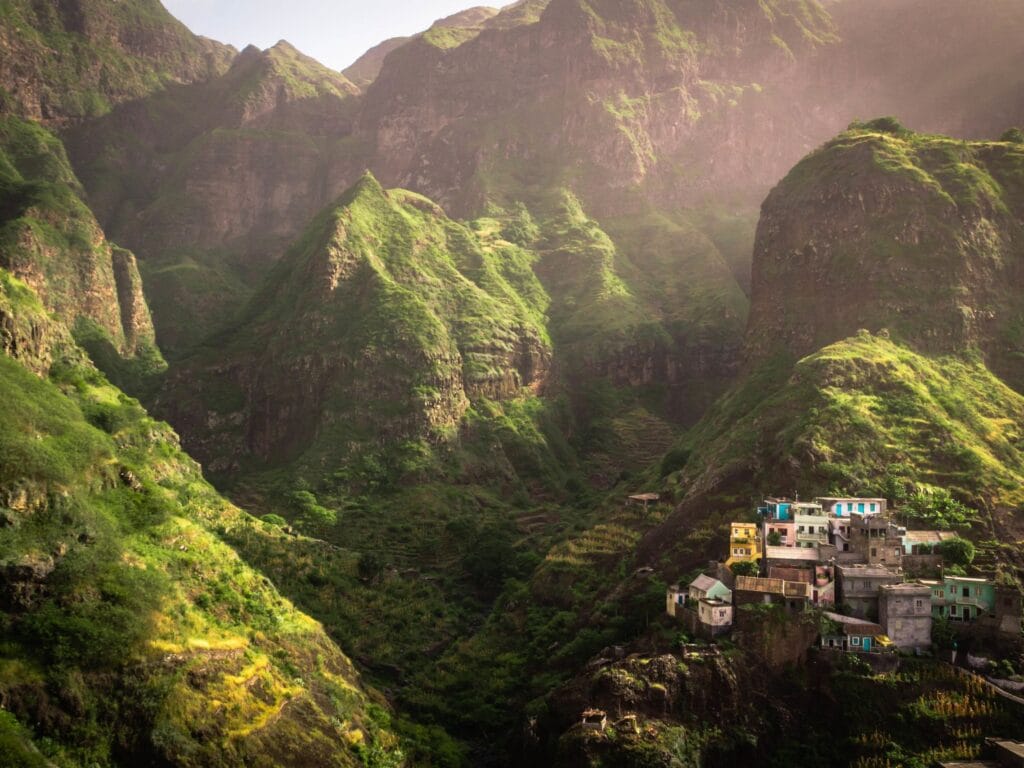
Living with volcanic risk
Villages built on ancient lava flows
Agriculture adapted to volcanic ash
Periodic evacuations after eruptions
Here, the population lives with the volcano not as a constant threat, but as part of the natural cycle.